Nov. 21, 2025: I was standing in line wearing a fluffy white robe with just a swimsuit on underneath, inching along as loud music played and people hooted and hollered. After turning a corner in a narrow passageway, I saw my destination: a set of steps leading from the third deck of our ship down to some of the coldest water in the world. I detected a slight wind, which grew stronger over the next few minutes as my position became more exposed. I started to shiver but I told myself that soon, this experience I had been both dreading and thrilled about would be over. Ahead of me lie the deep-blue, 30-degree waters of Antarctica. Yes, the lonely, inhospitable, often brutally cold Seventh Continent and the waters surrounding it. I was about to take the polar plunge that beats all polar plunges … because we were actually in a polar region.
Just when I began to brace myself for the jump, everything came to a halt. An elderly woman ahead of me had stopped on the edge of the small platform where I and about half our ship’s 160 passengers were lining up to jump into what were likely the coldest waters we’d ever touch. The two guides had already tied the required rubber belt around the reluctant passenger’s waist and hooked it to a cable for quick recovery if she sank too far or couldn’t swim back. They told her it was okay to wait a few seconds to work up her nerve. She waited a lot longer than that.
Behind her and atop the stairs, now fully exposed to the Antarctic wind, I began to shiver uncontrollably. A guide had already taken my robe and glasses. There was nothing standing between me and the moving air at the bottom of the Earth. I grew frustrated, and colder, as the woman continued to stall. I felt sorry for her. Finally, aware of the long line behind her, the two guides on each side said they’d count to three and then she should jump. If she didn’t, they’d usher her back up the stairs. When the guides hit “three,” she finally leaned forward and took a short hop into the water. She didn’t stay in long. The guides pulled her back and helped her onto our ship, the Quark Expeditions World Explorer.
I was ready. I had been waffling about taking the plunge for days but decided I had no excuse. I also realized that I had traveled over 7,000 miles from my Upstate New York home and couldn’t go back and tell family and friends I chickened out. It was “go” time.
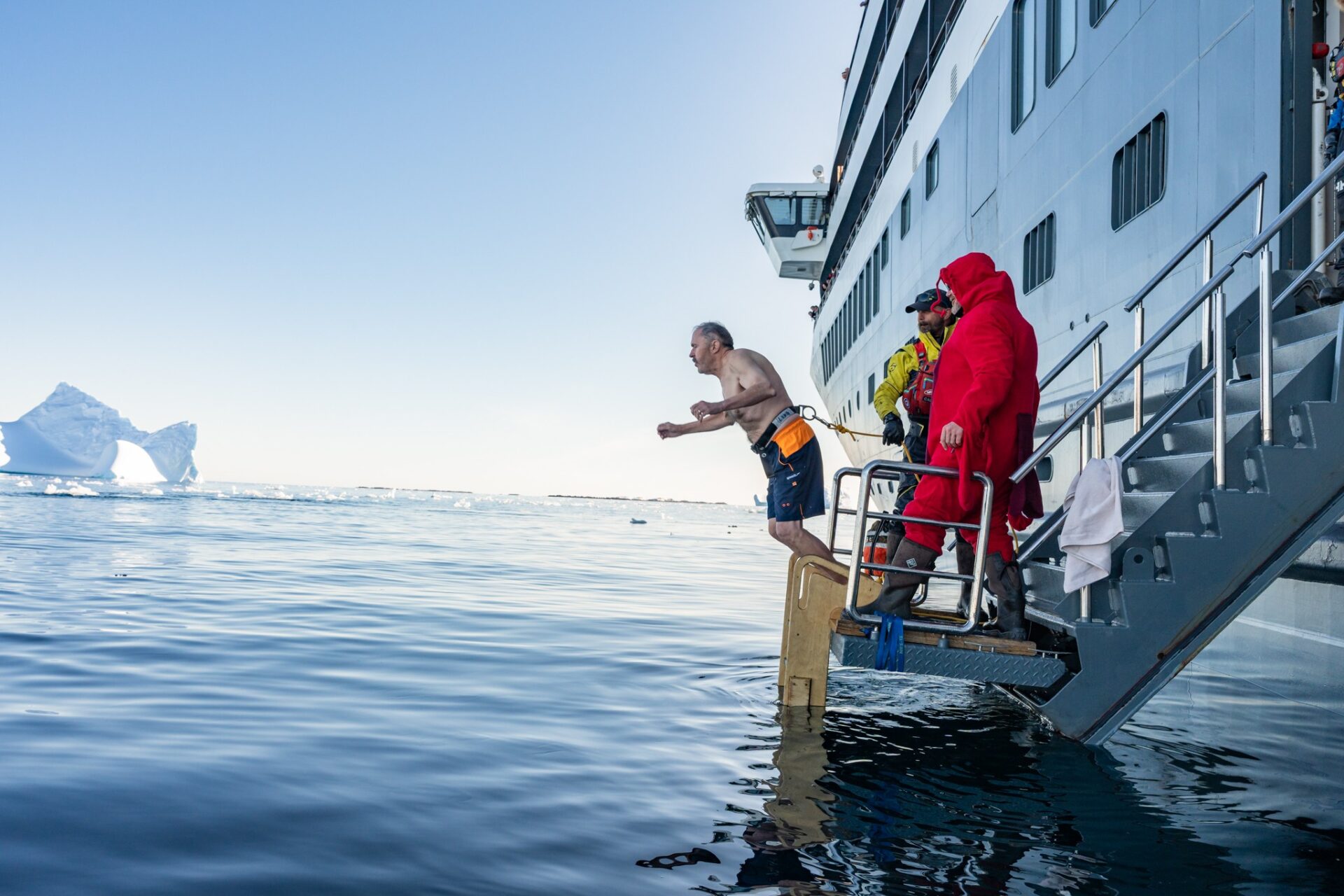
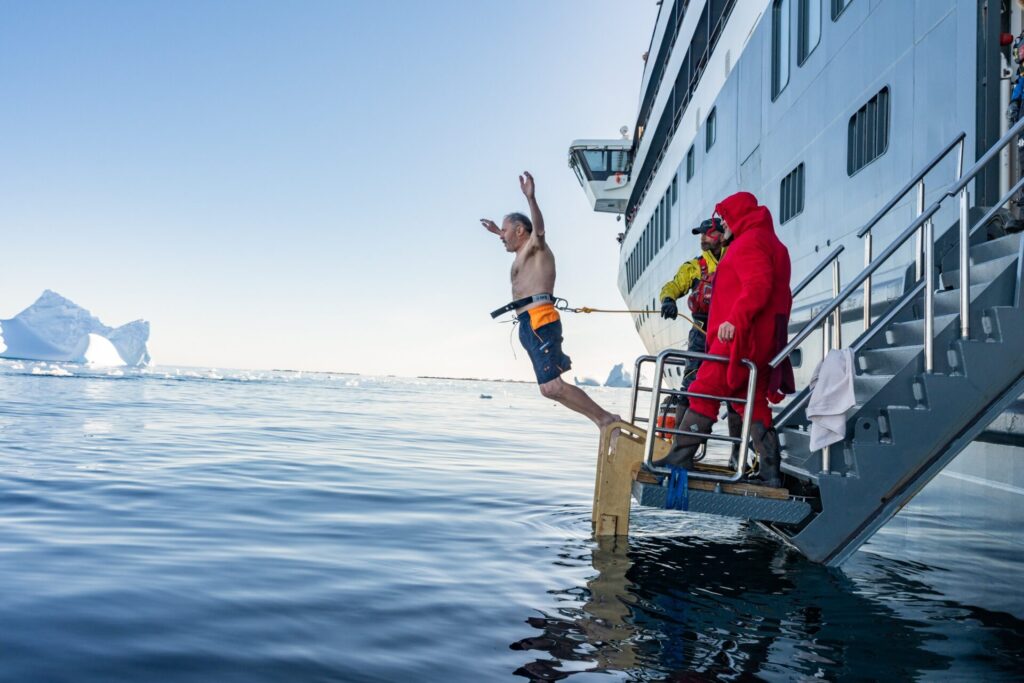
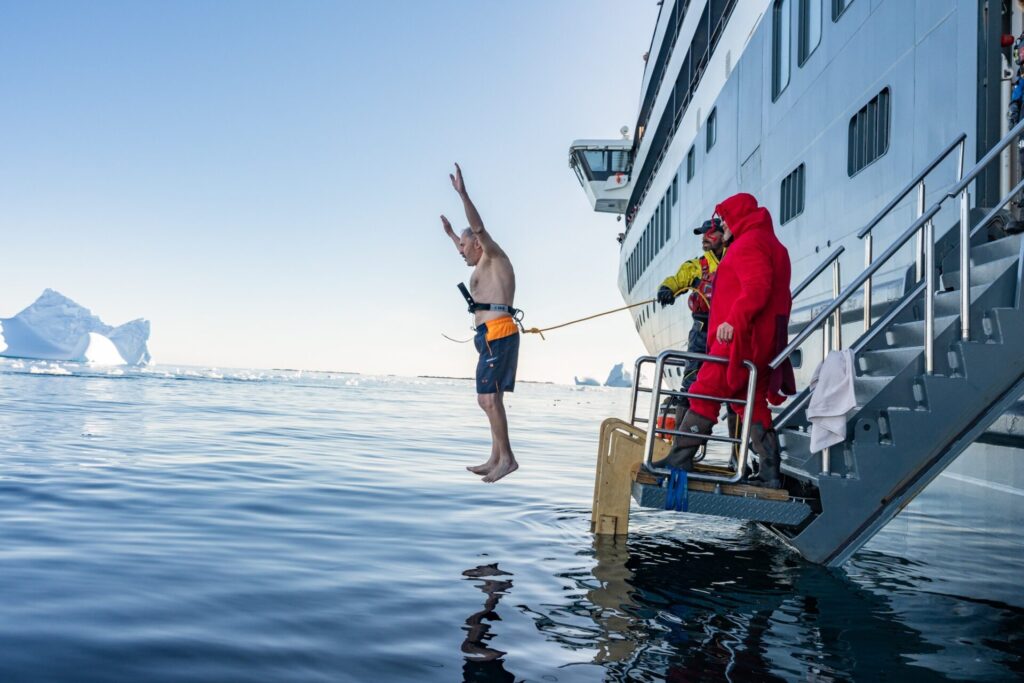
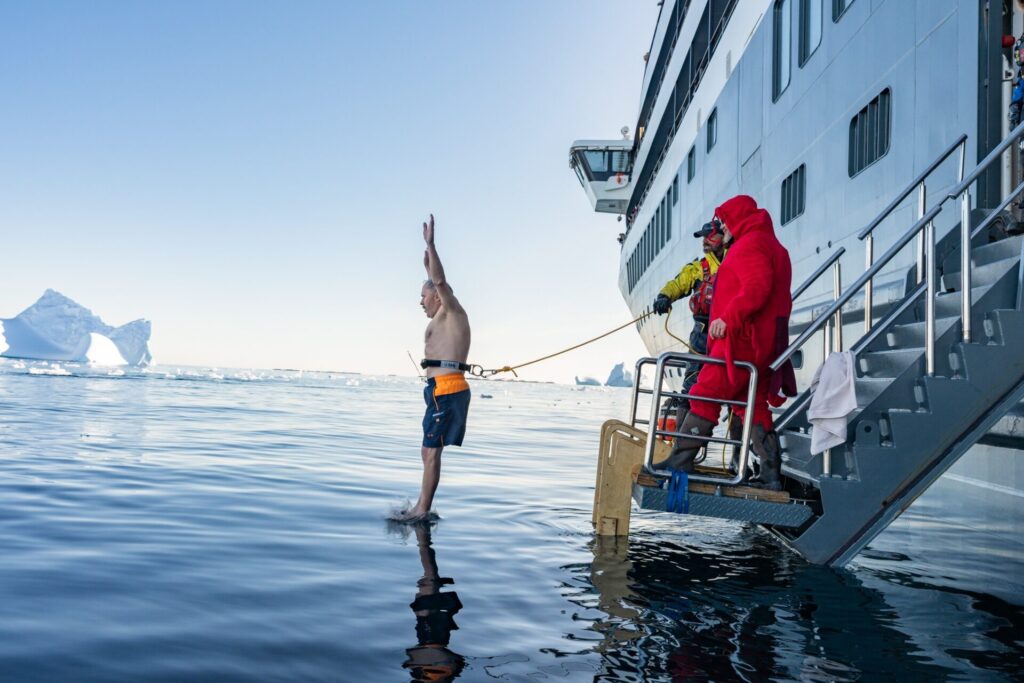
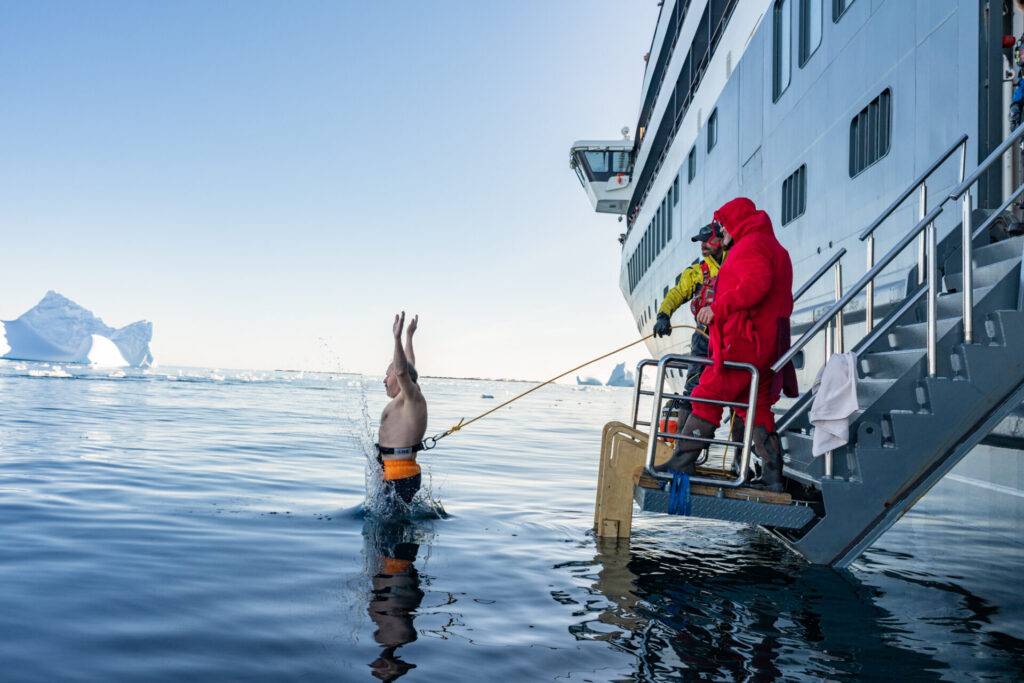
I reached the end of the small platform and stood aside two heavily clothed guides as one attached the cord to the waistband around my torso. Without hesitation, I leaned forward and propelled myself skyward. A ship photographer a few feet to my left captured my nearly perfect vertical jump. I traveled forward for 1-2 seconds before gravity took over. I recalled my older son Dan’s warning that the plunge might cause a heart attack. It was too late now. Maintaining my vertical posture, I entered the water feet first, and the series of photos captured me disappearing beneath the water with barely a splash.
The plunge photo sequence. Photos credit Quark Expeditions:
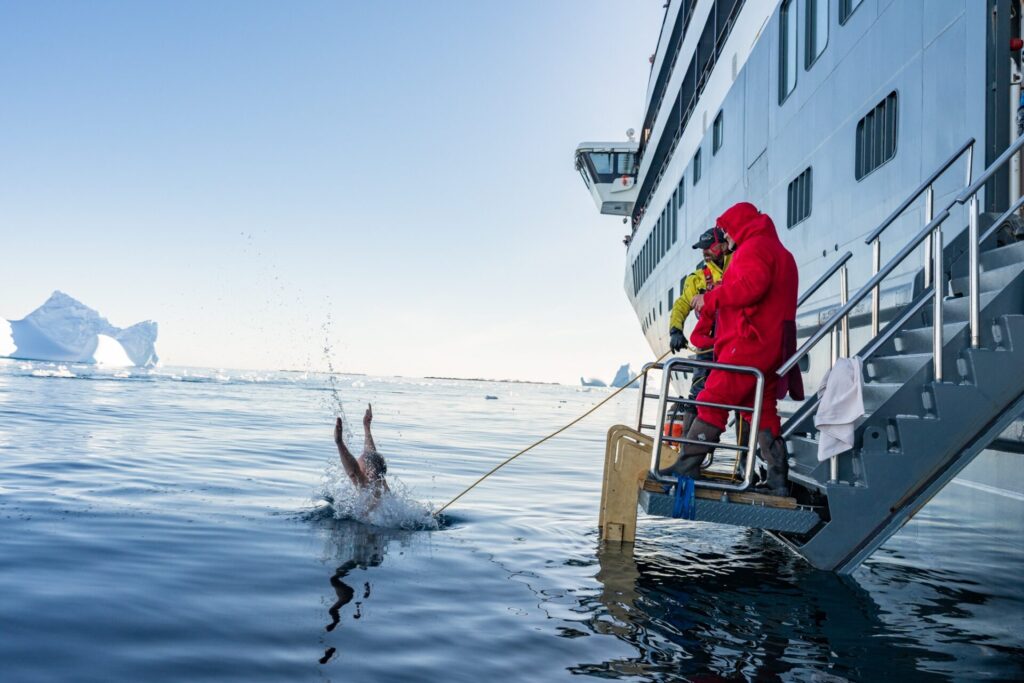
Underwater, all knowledge of the outside world was gone. The same icy waters that had frustrated and often trapped famous explorers like Shackleton, Amundsen, and Scott had severed my connection to the warm planet that had nursed me along for 69 years. The cold was so severe it hurt. I felt like a thousand ice picks were poking me from all sides. I slid deeper. I was consumed by thoughts of the penetrating presence of Antarctic waters swallowing me. Around me, I saw bubbles containing the air I had brought down with me. Without my glasses I couldn’t see that well, but I detected a dark blue of a hue I had never seen before. I sank deeper. The only sounds were deep gurgles and a whooshing of water past my ears. After what seemed like a minute or two, but in reality was only 3-4 seconds, I looked skyward. I saw bright light and started kicking my legs and pulling myself upward with my arms. It was a stupid thought, I realized later, but I didn’t want to be embarrassed by having to be reeled in.
I broke through the surface and felt even colder as the breeze hit me. I turned toward the ship and executed a strong freestyle stroke toward the guides, who were waiting near the wooden ladder of the platform. They grabbed my arms and helped me up. I clambered up the small ramp, and they handed me my robe and glasses. I was shivering badly but not enough to prevent me from high fiving a few waiting fellow plungers. I turned left toward the stairs back to my cabin two decks above.
There, I kept screaming to myself that I had done it. I shivered some more, changed out of my robe into a nice warm sweater and pants, and fired off a text to my wife, Elisa, and sons, Dan and Greg, half a world away: “BAD-ASS ALERT: Today I plunged into -1C or 30F Antarctic seawater to join the tiny percentage of the population to have done so. Cold, cold, cold. I completed it about 10 minutes ago. The Polar Plunge!”
The dive, as hazardous and frightening as it seemed, was a perfect ritual to launch the beginning of the end of my Quark Expeditions trip to Antarctica. Later that night I discovered my plunge had fueled my metabolism. At dinner, I downed two servings of steak and potatoes, three heaping scoops of ice cream, and five glasses of wine. Then I slept like the proverbial baby as our World Explorer ship turned north.
Nov. 22, 2025: My first look through my cabin windows revealed that the weather had changed overnight as we neared Portal Point on the Gerlache Strait on the Antarctic Peninsula. Gone were the deep-blue, cloudless skies and 30-degree temps we had enjoyed all week. Clouds had rolled in, and we were passing through light snow squalls.
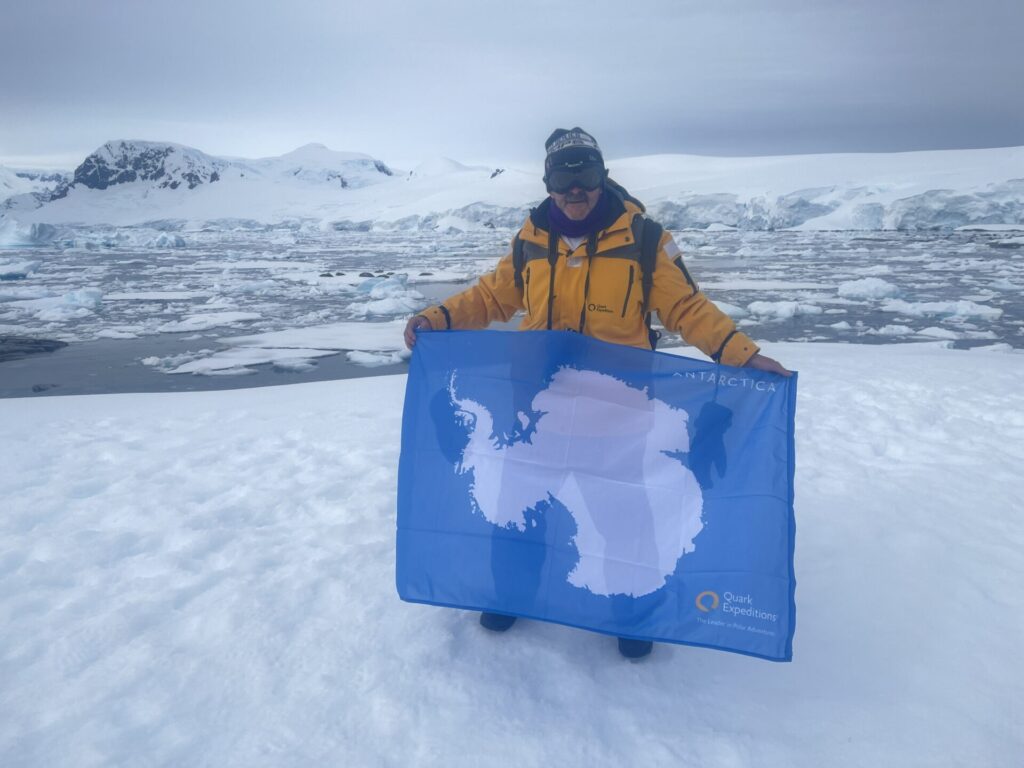
After breakfast, as we prepped for an outdoor excursion, the guides laughed and bragged that we’d now be experiencing “real” Antarctic weather. Our Zodiac rafts skimmed across calm waters and scattered ice floes to deliver us onto a rocky beach at Portal Point. The name comes from the location’s regular use as a gateway to the waters of the Antarctic Peninsula. After landing, the guides led us to a scenic outlook over a nearby bay for one of the few real “touristy” events: a photo while we held an Antarctic flag. When it was my turn, I struggled to hold the banner still against the increasing winds. It was a treasured shot. I was standing on Antarctic ice and snow with the flag. No caption needed. Behind me were hundreds of small, flat icebergs where large seals lolled around.
Joining others in my 10-person Zodiac group, I climbed a small hill to photograph a Gentoo penguin rookery. I felt sorry for the seabirds, which seemed to struggle against the blowing snow. Guides assured us this was normal for them. Even though I was wrapped in my parka and other cold-weather garb, these were the coldest temps I experienced during the trip.
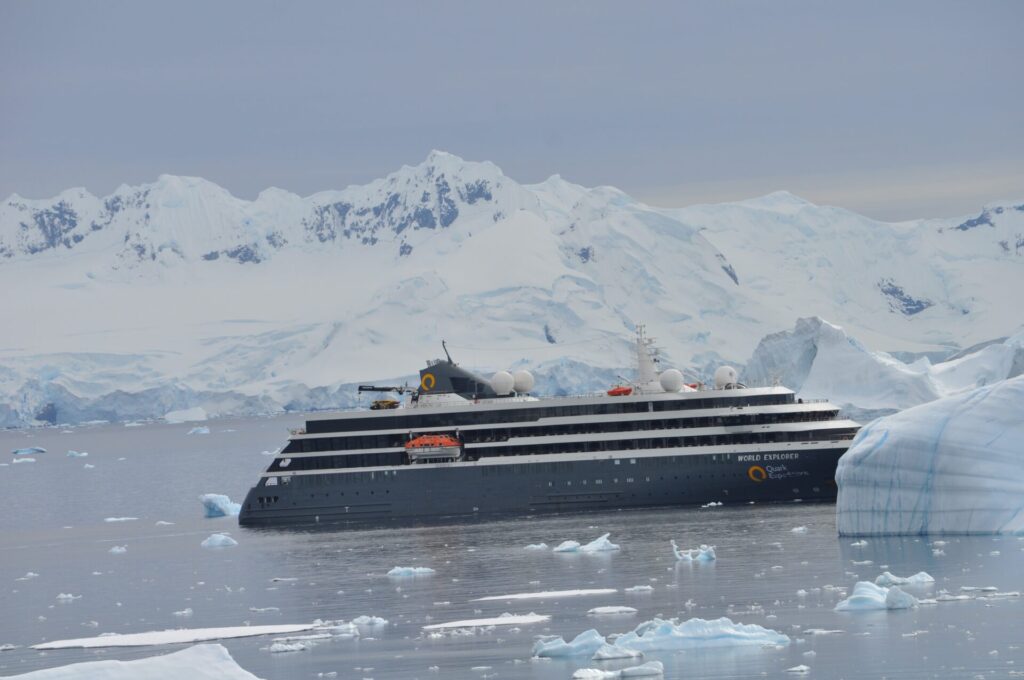
I joined other raft mates to hike up a small rise on Portal, avoiding a few crevasses marked by our guides. At the top of the hill, I stood for at least 10 minutes, staring at our ship in the distance. It was such a placid scene, one that made me wonder how early explorers felt in similar circumstances, facing the prospect of their ships getting stuck in ice or having to winter in Antarctica.
After lunch back at the World Explorer, we began boarding our Zodiacs in the usual 10-person teams for our last excursion before heading north to Argentina. Some passengers were getting weary of the excursions and cold. One, an older woman, told me she had stopped going out, and now preferred to view the Antarctic landscape from the ship’s deck. She wasn’t alone. We dispatched fewer Zodiacs for this excursion to rocky Palaver Point on Two Hummock Island, our last stop on the continent. Palaver is an old English term for noisy, ceaseless conversation. In this case, the name derives from the loud collection of Chinstrap Penguins found on or near the point. This breed of penguin is named for its distinctive head marking, which looks like a strap that starts at one ear, wraps around their necks, and ends at the other ear.
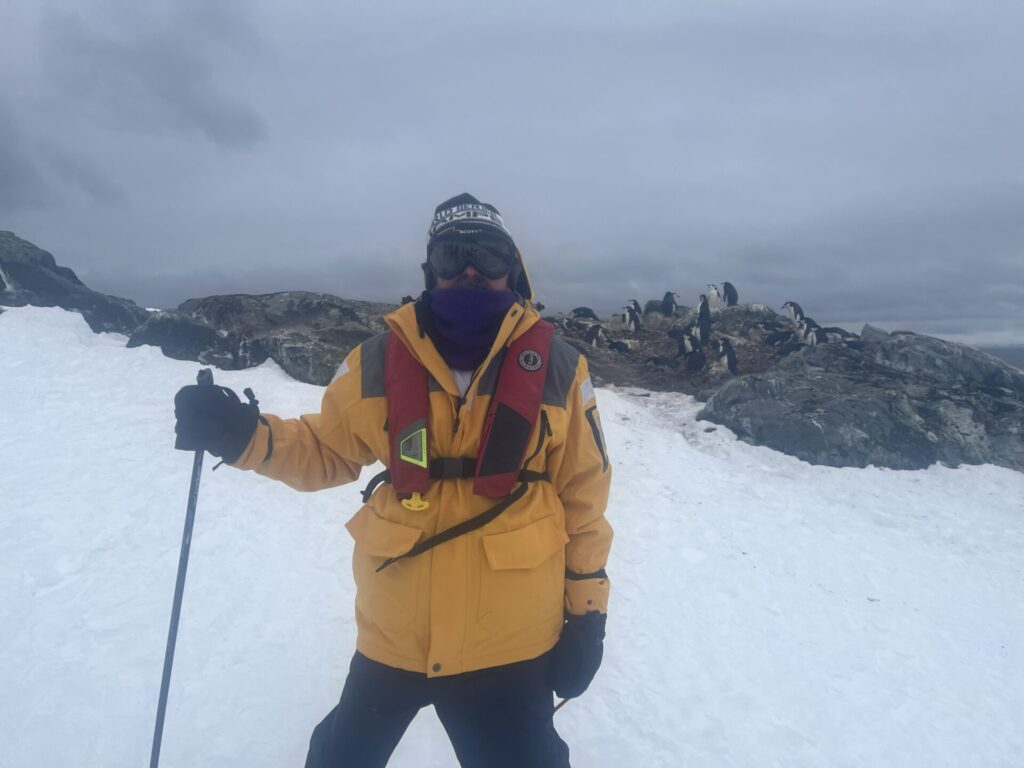
It was still windy with scattered snow squalls after we beached on Palaver. Trudging up a few short hills, we found the penguins easily because of their calls. Again, I felt it looked like they were suffering as they leaned into the wind.
Knowing this was likely my last trek on Antarctic land, I followed other passengers to hike all the trails the guides marked for us. At times some of our feet sunk over a foot into the snow. I almost fell. A few passengers did.
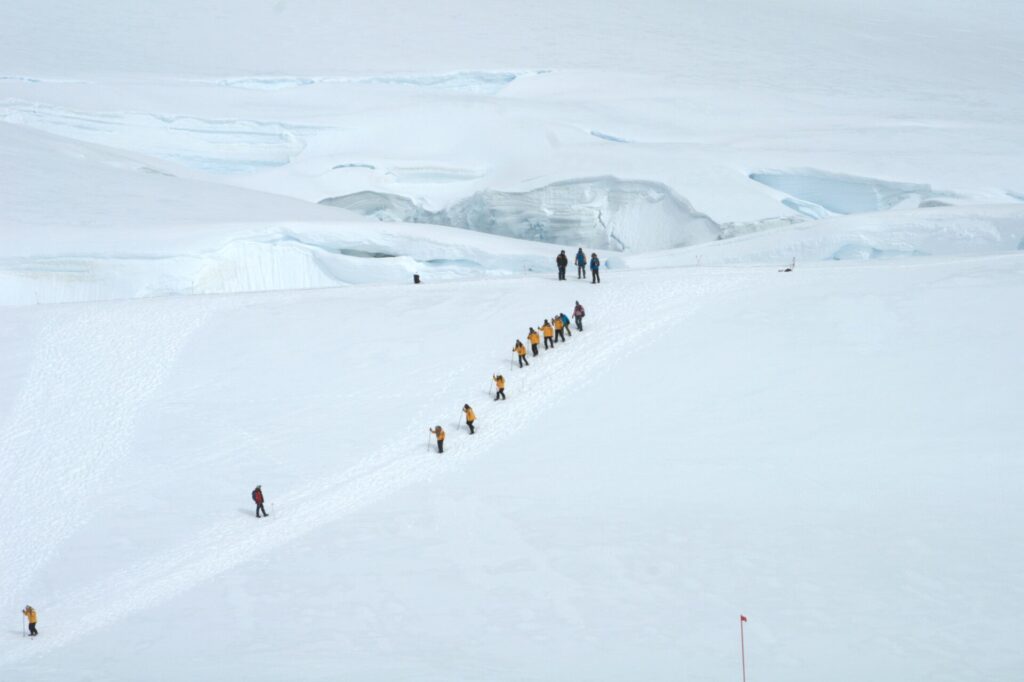
At the designated time, I turned back toward shore and my Zodiac. I stood still for a few minutes on one hill, absorbing a spectacular part of Earth, knowing I’d likely never see again. The wind whistled in my ears. Dim sunlight filtered through low, snow-filled clouds. Far away, grey and white peaks soared skyward. My fingers started to tingle from the cold. I pulled my parka hood up over my hat for one of the few times during the expedition. My fellow passengers near me had fallen quiet. Perhaps they too were saying their final goodbyes to this special place.
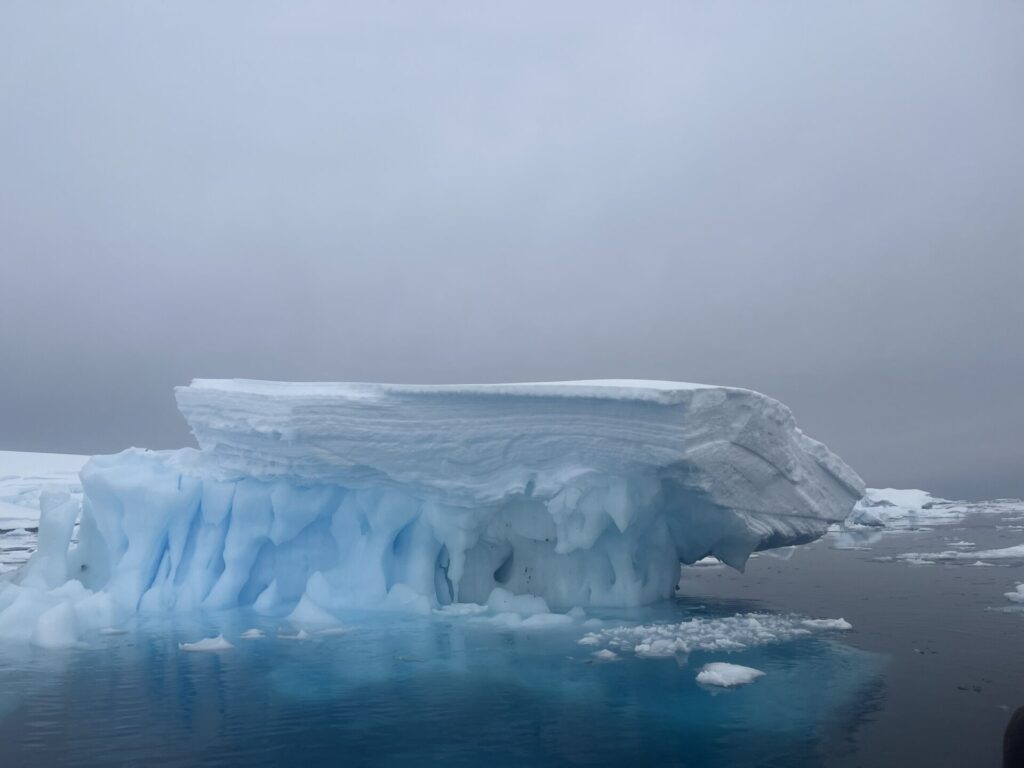
Back on the Zodiac, I kept to myself instead of engaging in the usual banter with raft mates. I wanted to savor these last few moments flitting across the bay, close to where it meets the Southern Ocean.
That night, again I kept to myself. I didn’t want the opinions and observations of fellow passengers to interfere with my own. It might seem silly now, but I felt I had to protect my memories.
Later that evening we headed north back into the Drake Passage. The forecast was for the same terrible weather we had experienced on the way down. I walked slowly back to my cabin as the Drake’s waves began pounding the ship. I took a motion sickness pill and went to bed.
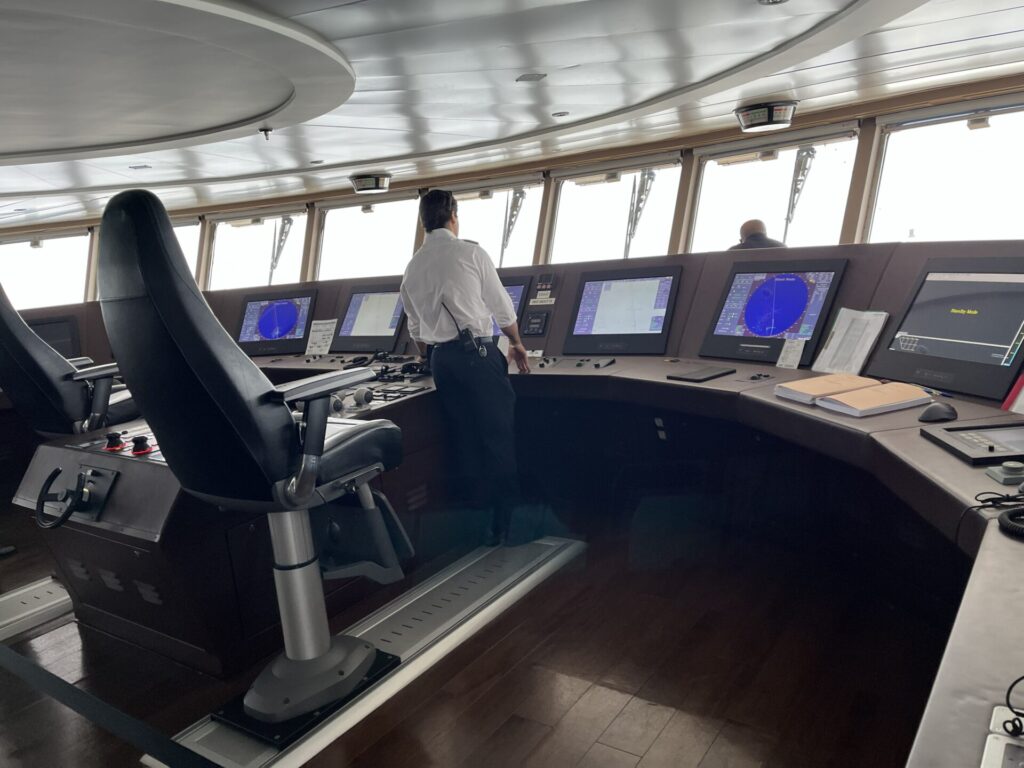
Nov. 23, 2025: After another restless night of waves tossing me about my bed, I took advantage of an opportunity to tour the ship’s high-tech bridge. I was fascinated by the displays, controls, and overall technology used to steer a 413-foot-long ship through Antarctic waters and the Drake. I was relieved to see that the technology was constantly backed up by a solitary crew member whose only job was to look out the front windows for obstacles and other dangers. He never took his eyes off the water as we visitors milled around.
I spent the rest of the day between meals reading on the couch in my cabin and reflecting on what I had seen. I’d also exhausted the free internet access Quark allots to each passenger. I was posting pictures daily on social media but had exceeded my limit. At the reception desk, I asked what it would cost to buy more data. The answer was about $150 for one more gig. I passed. Later, another passenger told me free Wi-Fi was available near the reception desk. I parked myself on a couch there for a few hours to post pictures, answer emails, and scan news I had missed. No one could make phone calls unless a special app was used. I didn’t know how to use those apps, so I stayed in touch with home via email and text messages.
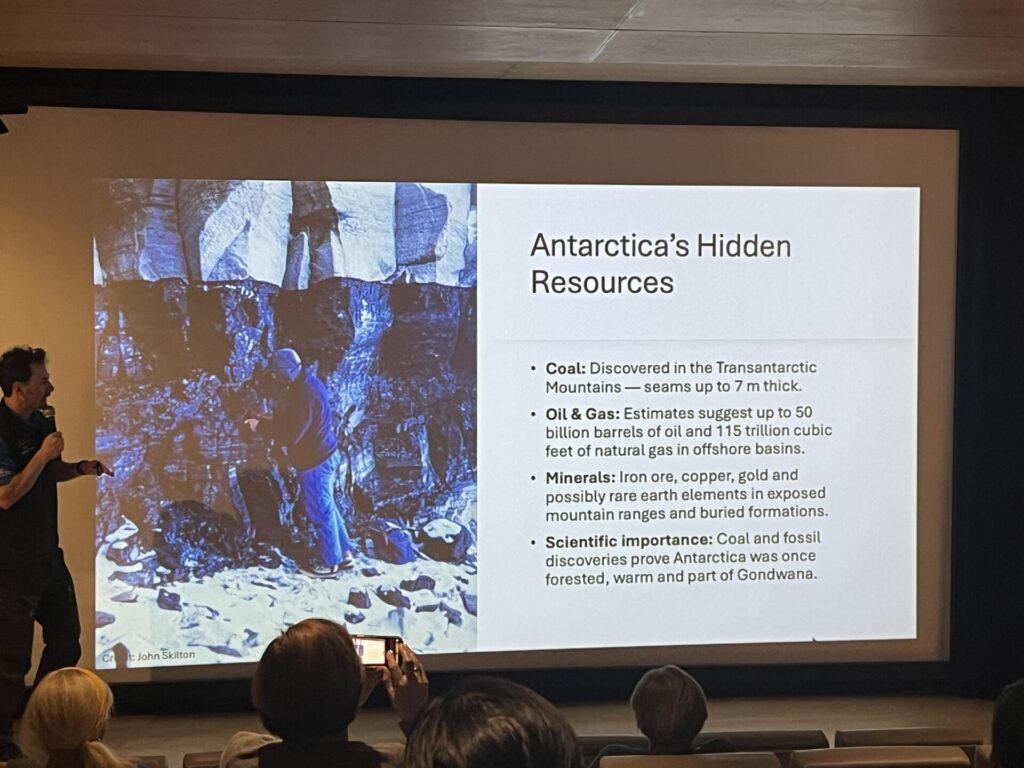
I spent the rest of the day attending science briefings in the auditorium. Some of the speakers had a hard time standing on the stage, due to the powerful waves slamming the hull behind them. That night I started to pack for home as I braced myself for another terrible night of sleep as we plowed through the Drake. I swallowed another motion sickness pill.
Overnight, I realized I was suffering from a gout attack in my left hand. This painful type of arthritis is caused by tiny crystals of uric acid that lodge in some of your joints, causing swelling, immobility of the joint, and terrible pain. My days and nights of eating rich food and drinking more wine than usual had caught up with me. I visited the ship doctor in the infirmary in the morning to seek a solution. Fortunately he had packets of colchicine, one of the few reliable prescription drugs that can fight off a gout attack. By the following day, I was feeling better.
Nov. 24, 2025: The Drake continued its onslaught today. Could our ship’s hull withstand this constant beating, I wondered? I wandered the ship from end to end on this last full day at sea, as best I could while the Drake waves bounced me from wall to wall.
I continued my packing prep and attended a midday briefing on our disembarkation procedures for the following morning. I’d need to have my large, heavy piece of luggage by my cabin door with the proper tags by 6 a.m. Back in my cabin, I knew I would have to figure out a way to pack everything I brought with me, and some additional gear. The biggest problem was the thick yellow parka Quark gave me when I boarded the ship. I tried to follow instructions from the debarkation briefing on how to roll up the coat and stuff it into a suitcase. After 5-6 attempts I gave up, folded the parka as best I could, and sat on the luggage as I zipped it. I got it closed. Barely.
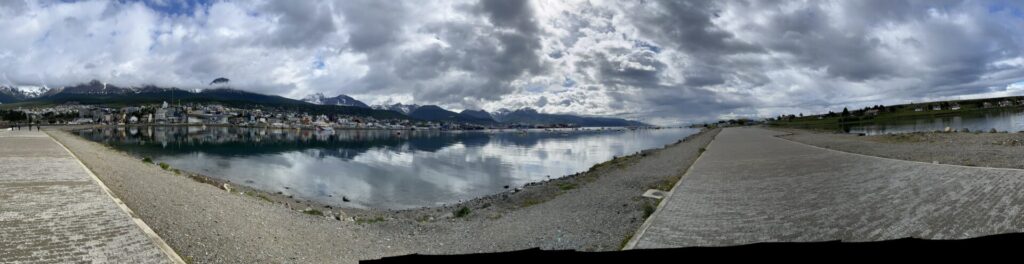
Overnight our ship finally reached the calm waters of the Beagle Channel, approaching Ushuaia, Argentina. I awoke once in the middle of the night and could see lights on shore as we slipped through the placid waters.
Nov. 25, 2025: After a quick breakfast we were called down to the lobby to board buses for downtown Ushuaia. On the way off the ship, a few guides and passengers hugged. I saw a few tears shed.
My flight north from Ushuaia to Buenos Aires wasn’t departing until mid-afternoon, so the bus dropped me and my luggage at a storage facility downtown. I left my suitcase there while I walked around and grabbed lunch. I strolled along the shoreline for three hours, snapping more pictures. Ushuaia is a lovely, small city but it’s busy with the comings and goings of travelers arriving for or leaving mountain climbing expeditions, hikes, and ocean-bound cruises.
My flight north from Ushuaia on an Aerolineas Argentnas Boeing 737 was crowded but uneventful. We touched down in Argentina’s capital city Buenos Aires around 5 p.m. local time. For the first time on the trip, my arrangements went awry. After getting off the plane and clearing a passport check, there was no driver waiting for me. I was confused and not sure what to do far away from home in a foreign country. Dozens of other drivers approached me and offered to drive me downtown, but I was leery of being scammed. I emailed my travel agent up in Montana. She did her best to help and suggested I look for the confirmation email for my driver on my phone. I found it and learned I could contact him via WhatsApp. I don’t have the app on my phone, but I quickly downloaded it. I could see the driver had been trying to reach me. My flight had arrived early so he squeezed in another fare, making him late to meet me. He was five minutes away from the airport.
The driver felt bad about being late, so he gave me a free tour of the city instead of bringing me right to my hotel. I enjoyed it. Even though he didn’t speak English, well I managed to understand we were passing by the president’s home and other important or historic buildings.
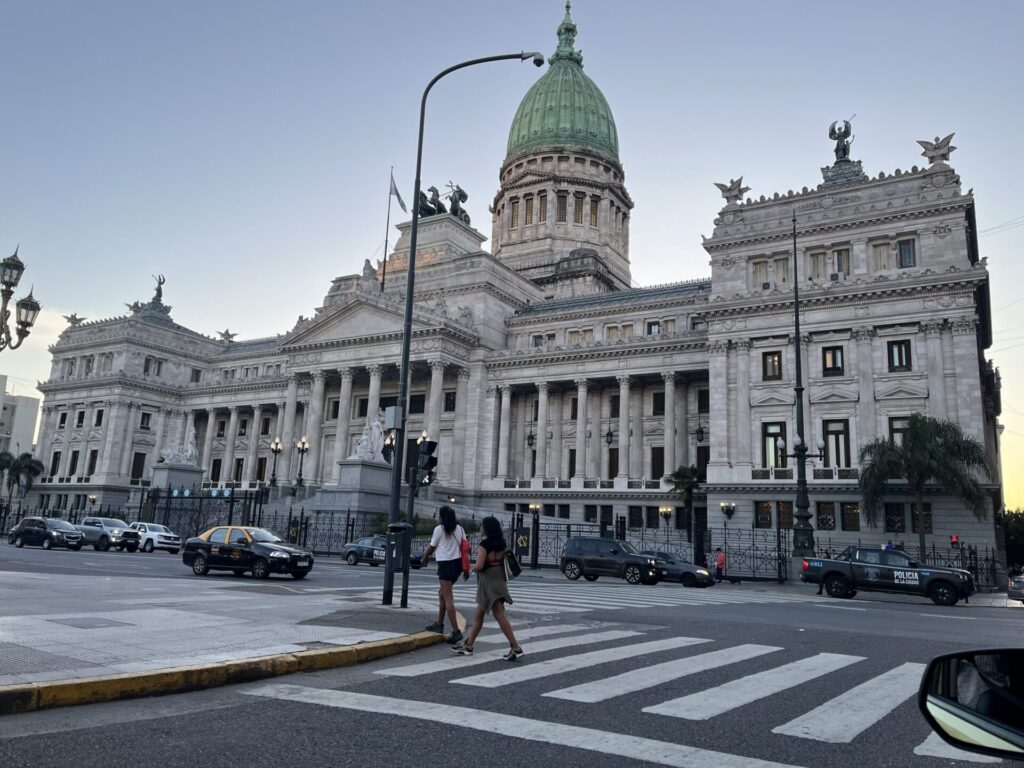
After checking in at my hotel, I bought a small sandwich at a nearby pub for my dinner. I talked to Elisa via phone for the first time in a week and went to bed at 9.
Nov. 26, 2025: On the day I began my long journey home, I started with a delicious pancake and fruit breakfast two blocks from my Buenos Aires hotel. Back in the hotel lobby, I checked out and dropped off my luggage for safekeeping since my flight didn’t depart until 10 p.m. After I tipped the hotel clerk $5 in U.S. cash, he was determined to help me find ways to spend my day exploring the city. He suggested a short walking route, and then a visit to a nearby museum devoted to the life of Eva “Evita” Peron, the one-time actress who served as Argentina’s first lady from 1946 until 1952. She became well known worldwide for her work as an advocate for poor and sick children while building hospitals and retreats for orphans and other youths. She also fought for women’s voting rights, among other causes. The self-guided museum tour takes visitors from her early days as a young starlet through her short time in the national spotlight. Many of her stunning formal clothes are carefully preserved in the facility, along with photographs and speeches from her work and tours within and outside the country.
I was surprised to learn that she died in 1952 from cervical cancer. She was 33 and at the peak of her popularity—so young to have had such an impact in Argentina and around the globe.
Outside the museum, it had grown much warmer and humid, a shocking change from the average 20-degree temps in Antarctica. I removed my jacket and stuffed it into my backpack.
With more time on my hands, I visited a Buenos Aires zoo. Giraffes, bison, colorful birds, small donkey-like creatures called Patagonian maras, elephants, and other animals strutted around their enclosures. Taking several sitting breaks in the heat, I watched dozens of school groups arrive and begin their march around the zoo. The scene evoked fond memories of chaperoning similar field trips back home with our two sons.
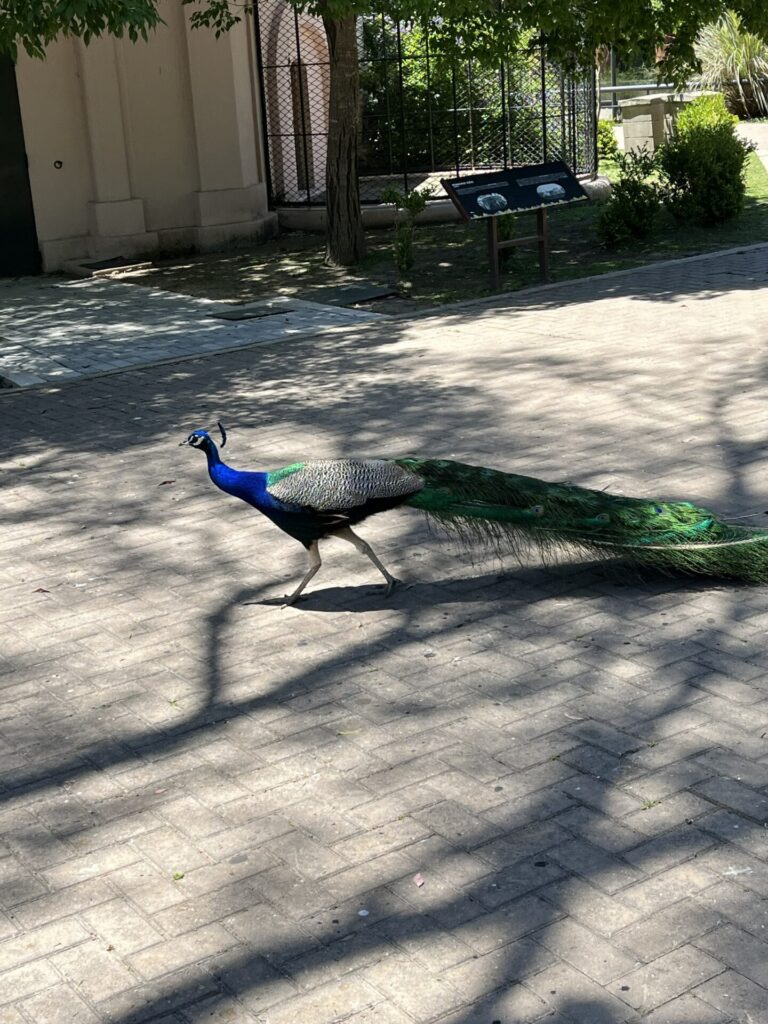
While walking in this beautiful capital city on my way down to Ushuaia two weeks earlier and on this departure day, I felt safe. Very few people spoke English, but I put my Google Translate app to good use.
After several hours in the zoo, I returned to my hotel to pick up my luggage and meet my driver for the trip to the airport. I had to pass through at least three passport checks after checking in my luggage at Delta.
I had a break before I was due at my gate, so I used the time to grab a bite and resume making notes about my adventure. These included thoughts about why it’s important to see and study Antarctica. To me, Antarctica is the “canary in the coal mine” that helps scientists and others learn what our warming climate could mean for the rest of the Earth. One example: Studying ice core samples there helps us understand how the levels of carbon dioxide in our atmosphere have passed what many consider a dangerous tipping point—compared with thousands of years ago. In a relatively short time, marked by the industrial revolution in the 1800s and the burning of fossil fuel, we have warmed our planet to the point that large ice sheets in Antarctica are either melting much faster or breaking off from the continent. According to NASA, if the entire Antarctic ice sheet melts, it could raise global sea levels by 180 feet. Every year, the sheet loses an average of 150 billion metric tons of ice. While such a catastrophic melt won’t happen soon, smaller ice melts could swamp some coastal cities. To put the amount of water contained in the continent’s ice sheet in perspective, somewhere between 70% to 90% of the world’s freshwater supply is locked up in the Antarctic ice.
The note-making and reflection were depressing me, so I finished dinner and headed off to my gate. As I boarded, I was required to pass one more check: a search of my carry-on knapsack. As I had done many times before, I had forgotten the water bottle in my pack was full and not permitted on board. The official checking my bag removed the bottle, saw my frown, and said in accented English, “Don’t worry.” She turned around and dumped the contents into a large plant behind her. “Have a good flight,” she said, and off I went to board, chuckling about her solution.
On board the Delta Airbus A-330, I found my seat to be much wider than the economy chair I had two weeks earlier. I had upgraded to premium economy for a small fee before my homeward trip. I also had no one sitting next to me. My 12-hour overnight flight to JFK International went quickly. I slept intermittently and woke up for good as the airplane banked several times over Queens before landing. Inside the terminal I passed through a U.S. Customs line quickly. As I had done before my trip, I had shaved my beard so I’d look more like my passport photo.
Outside the terminal on a windy, cold, gray Thanksgiving morning (Nov. 27, 2025), I found son Greg, a Brooklyn resident who’d be driving me home to Upstate New York for the holiday dinner. As in Buenos Aires, the sudden shift in weather was a shock to my system. I was cold, but home.
And I was bone tired. I fell asleep several times during the drive, dreaming that the rocking of Greg’s car around curves on the Taconic Parkway was caused by waves hitting my ship in the Drake Passage.
***
Links to the first two chapters (also in the menu on the right):